Thursday, March 14, 2013

March 14, 18, 19, 21

https://betalabs.nokia.com/sites/default/files/iStock_000012753624XSmall.jpg
According to the IBO, "Students are expected to evaluate the product/solution against the design specification in an objective manner based on testing, and to evaluate its impact on life, society and/or the environment. They are expected to explain how the product/solution could be improved as a result of these evaluations.

Students are expected to evaluate their own performance at each stage of the design cycle and to suggest ways in which their performance could be improved."

To get full marks the student:

  • evaluates the success of the product/solution in an objective manner based on the results of testing, and the views of the intended users,
  • provides an evaluation of his or her own performance at each stage of the design cycle and suggests improvements, 
  • provides an appropriate evaluation of the impact of the product/solution on life, society and/or the environment.

Let's recap what is needed in the Evaluate (Criterion E).

1. Print the questionnaire (that you created in the Investigate) and show your game to 5 people and ask them to answer your questionnaire.
2. Write a paragraph to "analyze" the feedback. In other words write about the scores that you received and say how your game could be improved. (Use phrases like: Based on my feedback I can conclude . . .)
3. Evaluate your performance at each of these stages of the design cycle: Investigate, Design, Plan, Create AND suggest ways that you can improve your performance. (You need 4 paragraphs here).
4. Write a final paragraph saying if you accomplished your goal and what impact it will have. (In other words, look at the unit question - were you successful? Explain. Relate back to the Area of Interaction.) Remember this is the final paragraph of your research project. It should finalize the project.


I will also need your Create (Criterion D). (Game, Process Journal and Documention)

Evaluate due March 21. Please submit on ManageBac and also a paper version.

IB Learner Profile: Reflective

Learning objective: carry out tests to evaluate the product/solution against the design specification; evaluate their perforance at each stage of the design cycle and suggest ways in which their perforance could be improved; evaluate the impact of the product/solution on individuals and/or society.


Thursday, February 28, 2013

Remember

http://www.kifalme.com/media/images/remember.gif


Year 11, remember that if you are using PowerPoint 2010 - you must use the advanced features.

1.No typing mistakes - remember that you have control over this.  Turn on the spell check and if in doubt, pull out a dictionary and look the word up to see if it is spelled correctly. http://blogmines.com/blog/2010/10/27/how-to-enable-check-spelling-as-you-type-feature-in-powerpoint-2010/
2. Don't forget to Deactivate the Mouse click feature: http://blogmines.com/blog/2010/11/08/how-to-disable-advance-slide-on-mouse-click-in-powerpoint-2010/
3.  Working with animations: http://office.microsoft.com/en-us/powerpoint-help/CH010371787.aspx
4.  Use Action Buttons - they make life easier: http://www.online-tech-tips.com/cool-websites/insert-action-buttons-into-a-powerpoint-presentation/
5. How to remove a background from a picture: http://theapptimes.com/powerpoint-2010-how-to-remove-a-picture-background
6.  How to embed a youtube video in a PPT: http://www.labnol.org/software/insert-youtube-video-in-powerpoint-presentations/5393/
7.  How to add music to a powerpoint presentation: http://www.online-tech-tips.com/ms-office-tips/add-music-to-a-powerpoint-presentation/
8. Recording audio in PPT 2010: http://blogs.voices.com/thebiz/2010/05/how_to_record_a_voice_over_for_powerpoint.html

Year 11, these are some of the features that I hope can help you.

Remember this Year 11 project should be student directed;-)

Learning Objective: The student will: use a range of appropriate techniques and equipment competently; ensure a safe working environment for themselves and others; follow the plan to produce the product/soltuion; evaluate the plan and justify any changes to the plan (when necessary); and create a product/solution of appropriate quality.

Wednesday, February 27, 2013

February 28, Mar 4, 5, 7

http://25.media.tumblr.com/tumblr_limyf0cwwN1qhq6u9o1_500.jpg


Now, it's on to the CREATE - Criterion D (Maximum 6)

Criterion D: Create Maximum 6
Students are expected to document, with a series of photographs or a video and a dated record, the process of making their product/solution, including when and how they use tools, materials and techniques.

Students are expected to follow their plan, to evaluate the plan and to justify any changes they make to the plan while they are creating the product/solution.

To get a 6 the student: competently uses appropriate techniques and equipment. The student follows the plan and justifies any modifications made, resulting in a product/solution of appropriate quality using the resources available.

Your assignment is as follows:
1.Follow your plan to create your game.   (Use your plan like a checklist and keep track of what went right and what went wrong;-)
2.You will need a "process journal" to submit along with your create. (Create a Process Journal using Google Docs, or a Word document include printscreens of your activity).
3.Finally, write a paragraph saying if your plan worked. Write a paragraph explaining any modifications you made. If you didn't make any modifications, please include a sentence saying that you didn't make any modification.

IB Learner Profile:  Knowledgable

Learning objective: utilize appropriate software, make appropriate choices of materials.

Wednesday, February 13, 2013

February 18, 19, 21

http://www.stubbleandglasses.com/wp-content/uploads/2012/05/keep-calm-and-make-a-plan-v1.png

Project Management - Planning

Year 10, it's time to plan. Criterion C - PLAN


According to MYP Technology, "Students are expected to construct a plan to create their chosen product/solution that has a series of logical steps, and that makes effective use of resources and time.

Students are expected to evaluate the plan and justify any modifications to the design."

To get a 5/6: The student produces a plan that contains a number of detailed, logical steps that describe the use of resources and time. The student critically evaluates the plan and justifies any modifications to the design.

Remember to use Project Management tools and vocab;-)

Plan Due February 21

IB Learner Profile: Thinker

Learning objectives:
1. construct a plan to create the product/solution that has a series of logical steps,
2. construct a plan to create the product/solution that makes effective use of resources and time,
3. evaluate the plan and justify any modifications to the design.

Monday, January 28, 2013

Jan 29, 31, February 7

Click on the image to enlargen

Next is the DESIGN (Criterion B) stage of the Design Cycle.

Students are expected to generate several feasible designs that meet the design specification and to evaluate these against the design specification.

Students are then expected to select one design, justify their choice and evaluate this in detail against the design specification.

To get a 5/6: The student generates a range of feasible designs, each evaluated against the design specification. The student justifies the chosen design and evaluates it fully and critically against the design specification.

For you to get a 5/6:  You generate 3 possible designs, each evaluated against the design specification. You justify the chosen design and evaluate it full and critically against the design specification.

FYI (For your information) - Here is an example of a design of a grammar review quiz/game that I made. Click on the above picture to enlarge it and look carefully at the image. Can you understand how this quiz/game will function?  This is an example of what I would like you to produce.

IB Learner Profile:

Design Due Thursday,  February 7 at end of class - it is not necessary to submit on ManageBac.

Learning Objective: generate several feasible designs that meet the design specification; evaluate the designs against the specification; select one design and justify its choice.

Sunday, January 27, 2013

January 28

http://www.bmhmcollege.com/wp-content/uploads/2011/07/tutorials-indosandster.jpg
Year 10, most of you have submitted your Investigation through ManageBac.  Congratulations to those of you who were able to accomplish that!

Today, I would like for you to submit a paper copy.  Thank you for your cooperation in this.

You have already decided on the social issue that you would like others to know about and which tool (programme) you are going to use.

Today I would like you to complete a tutorial on your chosen programme.

If you are using PowerPoint remember that we have just switched to PowerPoint 2013. Please do a tutorial to bring you up to speed on all the changes.

Also, you should know how to:
  • Deactivate the Mouse click
  • Work with animations
  • Use Action Buttons 
  • Remove a background from a picture
  • Embed a YouTube video in a PPT
  • Add music to a powerpoint presentation
  • Record audio in PPT 2013
IB Learner Profile: Inquirer

Wednesday, January 23, 2013

January 24


Formulate a design specification is on our plate for today;-)

The IBO defines Design Specification as: A detailed description of the conditions, requirements and restrictions with which a design must comply. This is a precise and accurate list of facts such as conditions, dimensions, materials, process and methods that are important for the designer and for the user. All appropriate solutions will need to comply with the design specification.

Let's look at the model and discuss what will achieve the highest marks.


To get a 5/6 the student: describes detailed methods for appropriate testing to evaluate the product/solution against the design specification.


3.  Formulate a Design Specification


My game for social change should have the following characteristics:

To test my game I will create a questionnaire. On a scale of 1-5 (1=awful, 5=awesome), I will ask the following questions:

Due January 24th.  Must be submitted 2 ways:  ManageBac and a paper version for assessment.

Learning objective: The student will list the specific requirements that must be met by the product/solution and design tests to evaluate the product/solution against the design specification.

Saturday, January 12, 2013

January 14, 15, 17

http://www.leafgrafica.com/images/home_winningdesign_normal.jpg


Year 10,  continue working so you can finish the Design Brief this week.  You will need to work on this project at home to complete it on time.

To recap our brainstorming activity resulted in the following research topics:

  •  social issues - choose one, explain why you have chosen it
  • video game genres - define, explain, compare/contrast different genres
  • research 3 different "games for change" to gather information and ideas. Summarize game, then analyse the game. 
  • research your topic and collect information to include in your game/activity
  • research programmes that you can use to make your game


IB Learner Profile: Inquirer

Learning objectives-The student will: independently identify meaningful questions, carrry out web search, select and organize appropriate sources and evaluate them.

Wednesday, January 9, 2013

January 10


Year 10, continue with the Investigation.

Let's brainstorm topics of research.

Sources of information:  Carefully consider the sources of information that you use.  Use experts in the field.  Remember, you will need a bibliography.  You will need to evaluate your sources.

Don't forget:
1.  Make sure your research is pertinent
2. Make sure your research is complete-it's your responsibility to be clear and concise
3. You need to use a range of sources
4. Make sure your research work is clearly and attractively presented

Appropriate language to use when documenting your research:
From my research I found out . . .
I have discovered that . . .
My conclusions are that . . .
I have kept my research relevant by. . .
Based on my research I can conclude  . . .


IB Learner Profile: Inquirer

Learning objectives: independently identify meaningful questions, carrry out web search, select and organize appropriate sources and evaluate them.

Tuesday, January 1, 2013

1 3 13


525,600 minutes - how will you spend them?


Year 10 Welcome back and Welcome to 2013 - This term gives you an opportunity to excel!

Before we broke for Christmas holiday we began on the introduction to our project (1.  Identify the problem). We agreed that the following elements are necessary components: stating the problem, discussing the relevance of the project, stating the solution to the problem, mentioning the "customer".  You must also connect this project to an area of interaction.

 2. Develop a Design Brief  - This is the 2nd step of the Investigate

1. Write a sentence or two to introduce this portion of your Investigation.

2. Then follow these learning objectives to success,

-formulate and discuss appropriate questions (4 or 5) that guide the investigation -this means that you should create questions and then do research that will help you solve the problem
identify and acknowledge a range of appropriate sources of information - use in-text referencing and create a bibliography
-collect, analyse, select, organize and evaluate information - this deeper analysis of your research will lead to higher marks
-evaluate your sources of informationwho are your sources? are they appropriate? are they experts in the field?

Girl Effect - an organization dedicated to helping young women in developing countries - check it out : http://www.girleffect.org/ 

IB Learner Profile - Inquirer
Learning objectives - The student will: Differentiate action verbs, independently identify meaningful questions, carry out web search, select and organize appropriate sources and evaluate them.

Sunday, December 16, 2012

December 17, 18

http://upload.wikimedia.org/wikipedia/commons/thumb/f/f9/New_Games_for_Change_logo.jpg/220px-New_Games_for_Change_logo.jpg
Year 10, let's move on.  Let's look at our new project.

As you know, each MYP Technology Class presents you with a problem to solve. The "problem" is the "guiding question";-) Our guiding question is: "How can I use computer technology to make people aware of social issues?"

The best way to begin your Investigation is by writing a paragraph that explains the problem as you understand it. Then write a paragraph to connect your project to an  Area of Interaction.

According to the Assessment Rubric. . .
To get a 1/2: The student states the problem.
To get a 3/4: The student describes the problem, mentioning its relevance.
To get a 5/6: The student explains the problem, discussing its relevance.

Look at these words: states, describes, explains. How are they different?
Look at these words: mentioningdiscussing. How are they different?

To help you decide which social issue check out sites like: Amnesty International, Greenpeace or do a keyword search on Google (social injustice issues)


Let's stick to social issues rather than environmental issues.

Click here for the Identify the Problem Template.


Then it's on to the 2nd task in the Investigation - "Develop a Design Brief."

1. Write a sentence or two to introduce this portion of your Investigation.

2. Then follow these learning objectives to success,

-formulate and discuss appropriate questions (4 or 5) that guide the investigation -this means that you should create questions and then do research that will help you solve the problem
identify and acknowledge a range of appropriate sources of information - use in-text referencing and create a bibliography
-collect, analyse, select, organize and evaluate information - this deeper analysis of your research will lead to higher marks
-evaluate your sources of informationwho are your sources? are they appropriate? are they experts in the field?

IB Learner Profile - Inquirer
Learning objectives - The student will: Differentiate action verbs, begin writing project intro (Identify the problem)independently identify meaningful questions, carrry out web search, select and organize appropriate sources and evaluate them.

Wednesday, December 12, 2012

December 13

http://www.colourbox.com/preview/2217333-597694-3d-illustration-of-checkbox-with-sign-done.jpg
Well done Year 10. You have completed your 1st Term project!

Before we move onto other topics, let's finish up a little business and organize our Design Folders.

Please create a cover page, and individual dividers for Investigate, Design, Plan, Create, and Evaluate.


Then, let's check out the cloud and see what we can see.

To work in the cloud please follow these steps to success:
1. login.microsoftonline.com
2. insert username/password (EXAMPLE: john.doe@student.oeirasinternationalschool.com)
3. Team Site
4. OIS Cloud
5. Students
6. Choose year group (click)
7. Subjects (click)
8. Then choose a specific subject (EXAMPLE: Computer Technology) (click)
9. Select class 1 or 2 (click)
10. Library Tab (click)
11. look at Manage Views Group
12. Current View
13. click on "Default"
14. change to "All Documents"
15. Documents tab (click)
16. Create Document (click)
17. Choose tool

Wednesday, November 28, 2012

November 29, December 3, 4, 6

http://us.123rf.com/400wm/400/400/iqoncept/iqoncept1110/iqoncept111000064/10913347-the-words-time-to-evaluate-on-an-ornate-white-clock-counting-down-to-the-moment-a-manager-will-perfo.jpg

EVALUATE - Criterion E


Let's recap what is needed in the Evaluate (Criterion E).

1. Print the questionnaire (that you created in the Investigate) and show your business card to 5 people and ask them to answer your questionnaire.
2. Write a paragraph to "analyze" the feedback. In other words write about the scores that you received and say how your business card could be improved. (Use phrases like: Based on my feedback I can conclude . . .)
3. Evaluate your performance at each of these stages of the design cycle: Investigate, Design,  Plan, Create AND suggest ways that you can improve your performance. (You need 4 paragraphs here).
4. Write a final paragraph saying if you accomplished your goal and what impact it will have. (In other words, look at the unit question - were you successful? Explain. Relate back to the Area of Interaction.) Remember this is the final paragraph of your research project. It should finalize the project. (You can begin like this.  I have met my unit goal as I have created a business card for  . . .)


IB Learner Profile: Reflective

Learning objective: carry out tests to evaluate the product/solution against the design specification; evaluate their perforance at each stage of the design cycle and suggest ways in which their perforance could be improved; evaluate the impact of the product/solution on individuals and/or society.

Saturday, November 17, 2012

November 19, 20, 22

http://n7ugc.disney.go.com/item/nyannyan/506_2gs11k6T9aQS000018hO185F-i-9466ba-as/disney%20create%20graffiti__180_135_q50.jpg

Year 10, now it's time to CREATE (Criterion D).

Your task is to use your plan like a checklist and follow the steps to create your business card.

The Create should take you 1 period to create.

According to the IBO: Students are expected to document, with a series of photographs or a video and a dated record, the process of making their product/solution, including when and how they use tools, materials and techniques. Students are expected to follow their plan, to evaluate the plan and to justify any changes they make to the plan while they are creating the product/solution. This means that you must have a process journal and that it is a necessary component of this criterion.

Include printscreens in your Process Journal.

To get a 5/6: The student competently uses appropriate techniques and equipment. The student follows the plan and justifies any modifications made, resulting in a product/solution of appropriate quality using the resources available. This means that you must write a paragraph saying if your plan worked.

IB Learner Profile: Knowledgeable

Learning Objective: The student will: use a range of appropriate techniques and equipment competently; ensure a safe working environment for themselves and others; follow the plan to produce the product/soltuion; evaluate the plan and justify any changes to the plan (when necessary); and create a product/solution of appropriate quality.

Tuesday, November 13, 2012

November 14

https://blogger.googleusercontent.com/img/b/R29vZ2xl/AVvXsEha3UNaZ4Vx9eguj0v1i0e_12fdkBZw3RtFz7rmcmdrb0xQTxOUgqryYlSCn-ekQWSCUdhu3YeA2yCnStfMj8_YWVUC9uH3oZB9auPZwOImETeaBxOJ67n8lrAHWeN1oKmEz8n2yyCKD4Y/s400/stop+the+presses.jpg
Year 10, let's take a closer look at our PM work. We´re going to regroup and reorganize.

1.  Work Breakdown Structure - Make a graphic (WBS) (this will be very simple as we are primarily concerned with a production plan.
2.  Work Package Distribution - Make a list of task for each item in your WBS.  Include Time.
3.  Gantt Chart - Use template to create a Gantt chart to graph your tasks and time.

Year 10, I think that now we are sorted.

Due Date - November 15 at end of class

IB Learner Profile: Thinker

Learning objectives: 1. construct a plan to create the product/solution that has a series of logical steps, 
2. construct a plan to create the product/solution that makes effective use of resources and time, 
3. evaluate the plan and justify any modifications to the design.

Tuesday, November 6, 2012

November 6, 8

http://heymonicab.com/wp-content/uploads/2009/01/make_a_plan2.jpg

According to MYP Technology, "Students are expected to construct a plan to create their chosen product/solution that has a series of logical steps, and that makes effective use of resources and time.

Students are expected to evaluate the plan and justify any modifications to the design."

To get a 5/6: The student produces a plan that contains a number of detailed, logical steps that describe the use of resources and time. The student critically evaluates the plan and justifies any modifications to the design.

Remember to use Project Management tools and vocab;-)

IB Learner Profile: Thinker

Learning objectives:
1. construct a plan to create the product/solution that has a series of logical steps,
2. construct a plan to create the product/solution that makes effective use of resources and time,
3. evaluate the plan and justify any modifications to the design.

Sunday, November 4, 2012

November 5

http://www.projects.uts.edu.au/images/diagram2.gif
University of Technology Sydney

Welcome back Year 10.  I hope you had a great break.

This class is going to be for information purposes only.
  • Criterion A - Investigate
  • Criterion B - Design - remember that ALL your designs must be "feasible" designs. That means that each of them must meet all of your design specifications.  This is easy to accomplish.
  • Criterion C - Plan  - Project Management - You are to plan your work for your business card project using the tools and concepts from Project Management.
    • Some go to terms are:
      • Work Breakdown Structure (WBS) - a structural way of identifying the work to be done by breaking down work into Work Packages (WPs) (tasks to be done);
      • Work Package Description (WPD) - a description of the Work Packages (tasks);
      • Gantt Chart - a graphical way of displaying the work to be done (taken from the WBS).
Project Management
  • What is Project Management?  According to Wikipedia, "Project management is the discipline of planning, organizing, securing, managing, leading, and controlling resources to achieve specific goals. A project is a temporary endeavor with a defined beginning and end (usually time-constrained, and often constrained by funding or deliverables),[1] undertaken to meet unique goals and objectives,[2] typically to bring about beneficial change or added value." http://en.wikipedia.org/wiki/Project_management
  • We are generally concerned with: 

    Planning and design

    After the initiation stage, the project is planned to an appropriate level of detail (see example of a flow-chart).[24] The main purpose is to plan time, cost and resources adequately to estimate the work needed and to effectively manage risk during project execution. As with the Initiation process group, a failure to adequately plan greatly reduces the project's chances of successfully accomplishing its goals.
    Project planning generally consists of[26]
    • determining how to plan (e.g. by level of detail or rolling wave);
    • developing the scope statement;
    • selecting the planning team;
    • identifying deliverables and creating the work breakdown structure;
    • identifying the activities needed to complete those deliverables and networking the activities in their logical sequence;
    • estimating the resource requirements for the activities;
    • estimating time and cost for activities;
    • developing the schedule;
    • developing the budget;
    • risk planning;
    • gaining formal approval to begin work.
  • Why Project Planning is useful:
    A key to successful project scheduling is to break down the project goals into tasks BEFORE you consider delivery dates, resource constraints, specific named resources, or task dependencies. This helps you to objectively identify all of the work necessary without subconsciously leaving out real work in order to fit date constraints. 
    The WBS step helps accomplish the following key objectives:
    § Develops an objective, rational view of the amount of work required
    § Helps team grasp the skills required and amount of resources required for the project
    § Provides a clear framework for assigning to individuals a clear task definition and delegate the responsibility for completion
    § Lays a foundation for analyzing the task dependencies and for isolating and managing risks
    § Lays a foundation for developing a bottom-up estimate for the project schedule
    § Allows tradeoffs to be made consciously and with the proper consensus involved.
Links for you to check out to successfully execute your tasks.

IB Learner Profile: Thinker

Learning objectives: 1. construct a plan to create the product/solution that has a series of logical steps, 
2. construct a plan to create the product/solution that makes effective use of resources and time, 
3. evaluate the plan and justify any modifications to the design.

Wednesday, October 24, 2012

October 25

http://blogs-images.forbes.com/kenrapoza/files/2011/05/do-over-sample1.jpg

Year 10 we missed most of our last class because you were scheduled for school photos. Sooooo, let's take take this time to have a "do over".

I have some "found time" and today we have 2 tasks.

If you like, during period 4 you can check over your Criterion B (Design) and make sure that it is complete. You can use period 4 to make any changes and resubmit it.

Remember that before you can begin Criterion C (Plan), you need to become proficient with the programme that you will use to create your business card. Please use period 5 to complete any tutorials and experiment with the programme that you will use to enable you to effectively and efficiently  proceed with the next stage of the Design Cycle (Criterion C - Plan) to produce a production plan to create your final product.

IB Learner Profile:  Inquirer

Learning objective: The student will become proficient using a productivity tool.

Wednesday, October 17, 2012

October 17

http://www.bmhmcollege.com/wp-content/uploads/2011/07/tutorials-indosandster.jpg
Year 10, you did it again.  You met your deadline.  Congrats!!!

Before you can continue, you need to become proficient with the programme that you will use to create your business card.

Today, I would like you to complete a tutorial on the programme that you will use.  This will enable you to effectively and efficiently produce a production plan to create your final product.

IB Learner Profile:  Inquirer

Learning objective: The student will become proficient using a productivity tool.

Saturday, October 13, 2012

October 15, 16

http://www.keepdesigning.com/wp-content/uploads/2008/06/indian-henna-design-vectors-example-keepdesigning-com.jpg
Year 10, I've got to congratulate you on your designs. They are really great!

Remember that each of your designs must be feasible (possible) and that they all meet your design specifications.

Today I would like you to:
  1. evaluate each of your designs against your design specification, then
  2. select one design and justify your choice and evaluate this in detail against the design specification.

 To get a 5/6: The student generates a range of feasible (possible) designs, each evaluated against the design specification. The student justifies the chosen design and evaluates it fully and critically against the design specification.

 IB Learner Profile Focus - Thinker

Learning Objective: generate several feasible designs that meet the design specification; evaluate the designs against the specification; select one design and justify its choice.

Tuesday, October 9, 2012

October 11

http://www.36point.com/articles/bestbizcard%5B2%5D.jpg
Well done Year 10.  You met your deadline! Now, it's time to move on to the 2nd stage of the Design Cycle.

Next is the DESIGN (Criterion B) stage of the Design Cycle.
  • Students are expected to generate several feasible designs that meet the design specification and to evaluate these against the design specification.
  • Students are then expected to select one design, justify their choice and evaluate this in detail against the design specification.

To get a 5/6: The student generates a range of feasible (possible) designs, each evaluated against the design specification. The student justifies the chosen design and evaluates it fully and critically against the design specification.


IB Learner Profile Focus - Thinker


Learning Objective: generate several feasible designs that meet the design specification; evaluate the designs against the specification; select one design andjustify its choice.

Tuesday, October 2, 2012

October 4

http://www.technologystudent.com/images4/specy3.jpg

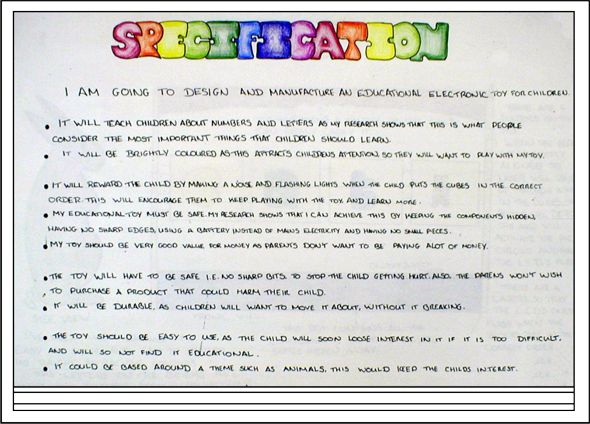
Year 10, the third step of the Investigation is 3. Formulate a Design Specification.

The IBO defines Design Specification as: A detailed description of the conditions, requirements and restrictions with which a design must comply. This is a precise and accurate list of facts such as conditions, dimensions, materials, process and methods that are important for the designer and for the user. All appropriate solutions will need to comply with the design specification.

To get a 5/6 the student: describes detailed methods for appropriate testing to evaluate the product/solution against the design specification.

Your task is to create a detailed list of design specifications and justify your choice.  Then create tests to evaluate your product.

IB Learner Profile: Inquirer

Learning objective: The student will list the specific requirements that must be met by the product/solution and design tests to evaluate the product/solution against the design specification.

Monday, October 1, 2012

October 2

https://blogger.googleusercontent.com/img/b/R29vZ2xl/AVvXsEjiFKbH5Eamh6N3KnpihN0Xib8sVFb9dNvAtBzYRaIjRskJLNkczI7VnK0rGlsiUsnb9kMWC5vRgBeF-uqboRlt7sBYcuk83VbSrQqt9iGxH2tFua_VqyS0jha2877pPP5_nc_cwfVg0gjo/s1600/design_brief.jpg
Year 10


Let's look at the learning objective below.  This section of the Investigate is designed to help you develop your researching skills.  You are to ask meaningful questions, carry out web search, select and organize appropriate sources and evaluate them.

  • 2. Develop a Design Brief
    • Define “Business Card” (what is it?, how can it help you?)
    • Research Business Cards (what makes a good business card?, effective business card design)
    • Research 11 essential elements in a business card
    • Research business card designs to gather ideas and information.  Look at 4 business cards and analyze your findings.  What did you like about the card? What didn’t you like?  Be specific. What ideas did you get that you could use in your own business card?
    • Investigate programmes that could be used.


Remember that you can use the links in the sidebar to help you solve your problem.

IB Learner Profile: Inquirer

Learning objectives: independently identify meaningful questions, carry out web search, select and organize appropriate sources and evaluate them.

Thursday, September 27, 2012

September 27 - Let's recap, then continue October 1

http://media.npr.org/assets/img/2012/09/10/lightbulb-5be719f2444b54229b7a61a770cf2710bf246e2c-s51.jpg

Year 10, let's recap what we did in class today.

We will look again at the line of research that you could develop:


  • Develop a Design Brief
    • Define “Business Card” (what is it?, how can it help you?)
    • Research Business Cards (what makes a good business card?, effective business card design)
    • Research 11 essential elements in a business card
    • Research business card designs to gather ideas and information.  Look at 4 business cards and analyze your findings.  What did you like about the card? What didn’t you like?  Be specific. What ideas did you get that you could use in your own business card?
    • Investigate programmes that could be used.


Remember that you can use the links in the sidebar to help you solve your problem.

IB Learner Profile: Inquirer

Learning objectives: independently identify meaningful questions, carrry out web search, select and organize appropriate sources and evaluate them.

Wednesday, September 26, 2012

September 27

https://blogger.googleusercontent.com/img/b/R29vZ2xl/AVvXsEhx2q-tDw0QrVyTaAtJBFcbvT4xmUH8R6UhXnj40vKJebCAVc6cjshoOWzrroHdxECRfI6nkAmHyDs5k26-TNvkiMp-5w6V99Fa6fgnyZ6ZieuQo3ulRf7P8ohJl8NSOpf2f7t-kiTZO8sO/s1600/keep_calm_carry_on_poster.jpg

Year 10, we have a double today so you will be able to get a lot accomplished.

When conducting research remember to keep it relevant. Ask questions that are going to help you solve your problem. It is this way that you will learn effective and efficient researching skills.


Starting Questions:  Make a list of questions you will have to find answers to.  You should find the following prompts useful:  Why. . .?  When . . .?  Where . . .?  What . . .?  How many. . .?  How often . . .?  How much . . .?  Keep your questions relevant so you don't waste time;-) 

Use the Unit of Work to help guide you through the Investigation.

Sources of Information:  Carefully consider the sources of information that you use.  Use experts in the field.

don't forget . . .
     1.  Make sure your research is pertinent
     2.  Make sure your research is complete - it's your responsibility to be clear and concise
     3.  You need to use a range of sources of information
     4.  Make sure your research work is clearly and attractively presented

  possible language to use in your written work . . .
     From my research I found out . . .
     I have discovered that . . .
     My conclusions are that . . .
     I have kept my research relevant by . . .

IB Learner Profile: Inquirer

Learning objectives: independently identify meaningful questions, carrry out web search, select and organize appropriate sources and evaluate them.

Wednesday, September 19, 2012

September 20


Year 10, let's move onto the 2nd stage of the MYP Design Cycle - Develop A Design Brief

This is the part of the project where we conduct research that will enable us to solve the problem.  (We ask and  answer questions that will give you enough information and knowledge to complete your task and make your game).

Before we get started, let's take a look at the information listed below which will offer you assistance in documenting your work.

 2. Develop a Design Brief

Follow these learning objectives to success,

-formulate and discuss appropriate questions (4 or 5) that guide the investigation -this means that you should create questions and then do research that will help you solve the problem


identify and acknowledge a range of appropriate sources of information - use in-text referencing and create a bibliography


-collect, analyse, select, organize and evaluate information - this deeper analysis of your research will lead to higher marks


-evaluate your sources of informationwho are your sources? are they appropriate? are they experts in the field? 


Develop 4-5 pertinent questions to help drive your Investigation, then conduct research to answer each question. A good place to begin is by researching business cards and advertising.


Let's brainstorm other possible questions that would help you solve your unit problem.


Also, begin to think about Design Specifications;-)


Learning objectives: The student will independently identify meaningful questions, carrry out web search, select and organize appropriate sources and evaluate them.